Appearance-aware queries
Queries predict pooled backbone features for their matched instances, learning denser identity cues from single frames.
Can temporally stable object identities be learned without video supervision? QueenVIS shows that stronger image-trained queries can close much of the gap.
Video instance segmentation (VIS) requires models to detect, segment, and track object identities across frames, and most methods enforce this temporal consistency through video-level supervision. Image-only training approaches, with MinVIS as one prominent example, have challenged this assumption, reaching competitive VIS without video training by treating frames as independent images and associating instances only at inference. The field has nonetheless moved toward ever more elaborate video-trained trackers, which depend on costly temporally linked, identity-consistent annotations, leaving the image-only direction under-explored.
We revisit this direction and ask how far single-frame training can be pushed. A diagnostic analysis identifies object query quality as the under-explored bottleneck: queries trained only to localize objects within a frame drift apart across frames and destabilize association. QueenVIS introduces a query-centric framework for strengthening image-trained VIS. During single-frame training, we enrich Mask2Former queries with two auxiliary heads: a feature-prediction loss that aligns each query with the pooled backbone descriptor of its instance, and a center-prediction loss that injects spatial structure. Both heads are discarded at inference, adding zero parameters, and temporal identity is maintained by a training-free query-propagation and memory-bank scheme.
On YouTube-VIS and OVIS with a ResNet-50 backbone, QueenVIS consistently improves over MinVIS, with gains of up to +6.7 AP on YouTube-VIS, +4.8 AP on OVIS, and +10.3 AP on the long-sequence YouTube-VIS split. Beyond image-trained baselines, QueenVIS achieves 50.9 AP on YouTube-VIS and remains competitive with recent video-supervised state of the art, without processing a single video clip during training.
QueenVIS separates single-frame representation learning from training-free temporal association.
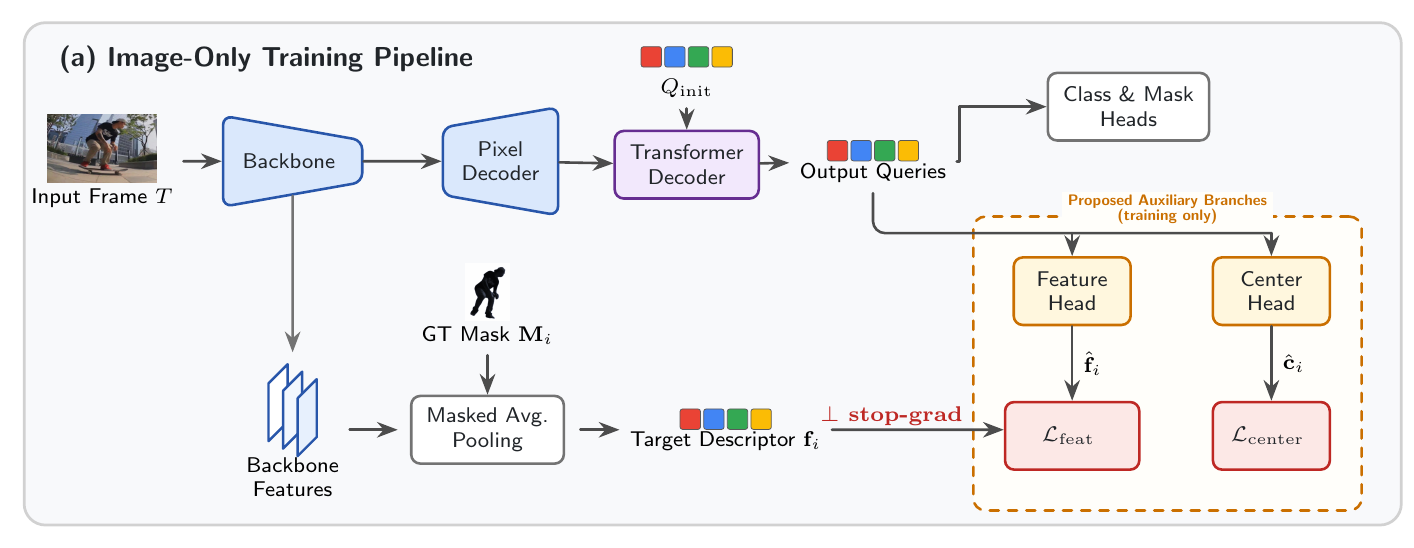
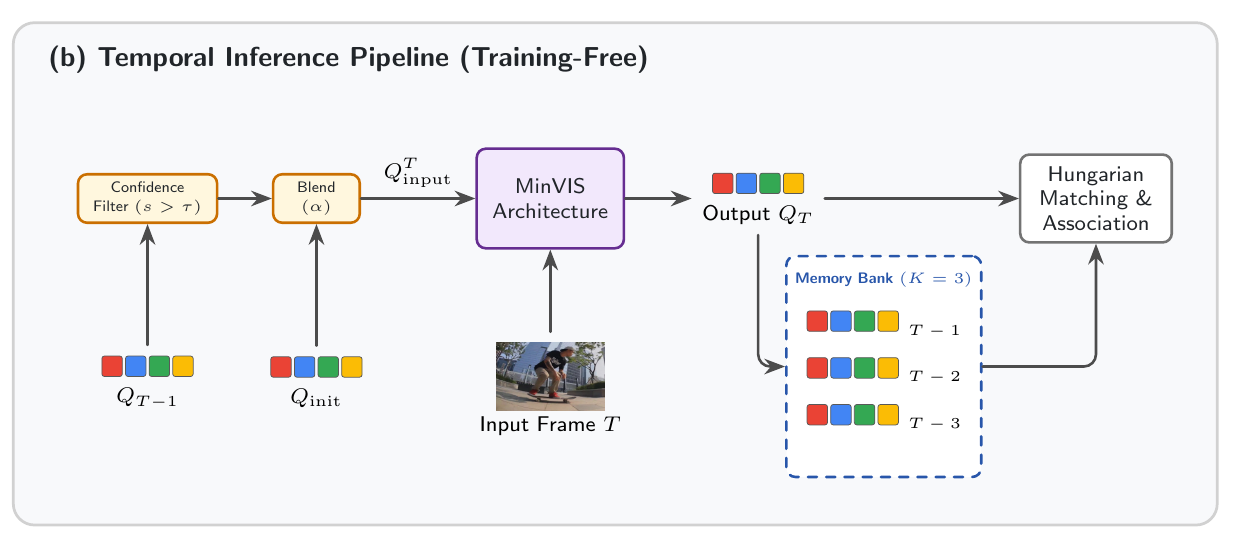
Queries predict pooled backbone features for their matched instances, learning denser identity cues from single frames.
A center-prediction objective injects explicit spatial structure, helping distinguish similar nearby instances.
Query propagation and a small memory bank maintain identity through appearance changes and occlusion.
All comparisons use a ResNet-50 backbone.
Improvement over the image-only MinVIS baseline.
Query enrichment closes much of the video-supervision gap.
A substantial improvement in the heavily occluded setting.
The largest gain appears where long-horizon association matters most.
| Method | Training | OVIS | YouTube-VIS 2019 | YouTube-VIS 2021 | YouTube-VIS 2022 Long |
|---|---|---|---|---|---|
| MinVIS | Image only | 25.0 | 47.4 | 44.2 | 23.3 |
| QueenVIS | Image only | 29.8 | 51.8 | 50.9 | 33.6 |
| Gain | - | +4.8 | +4.4 | +6.7 | +10.3 |
The auxiliary prediction heads are discarded after training, while QueenVIS maintains the same GFLOPs as MinVIS.
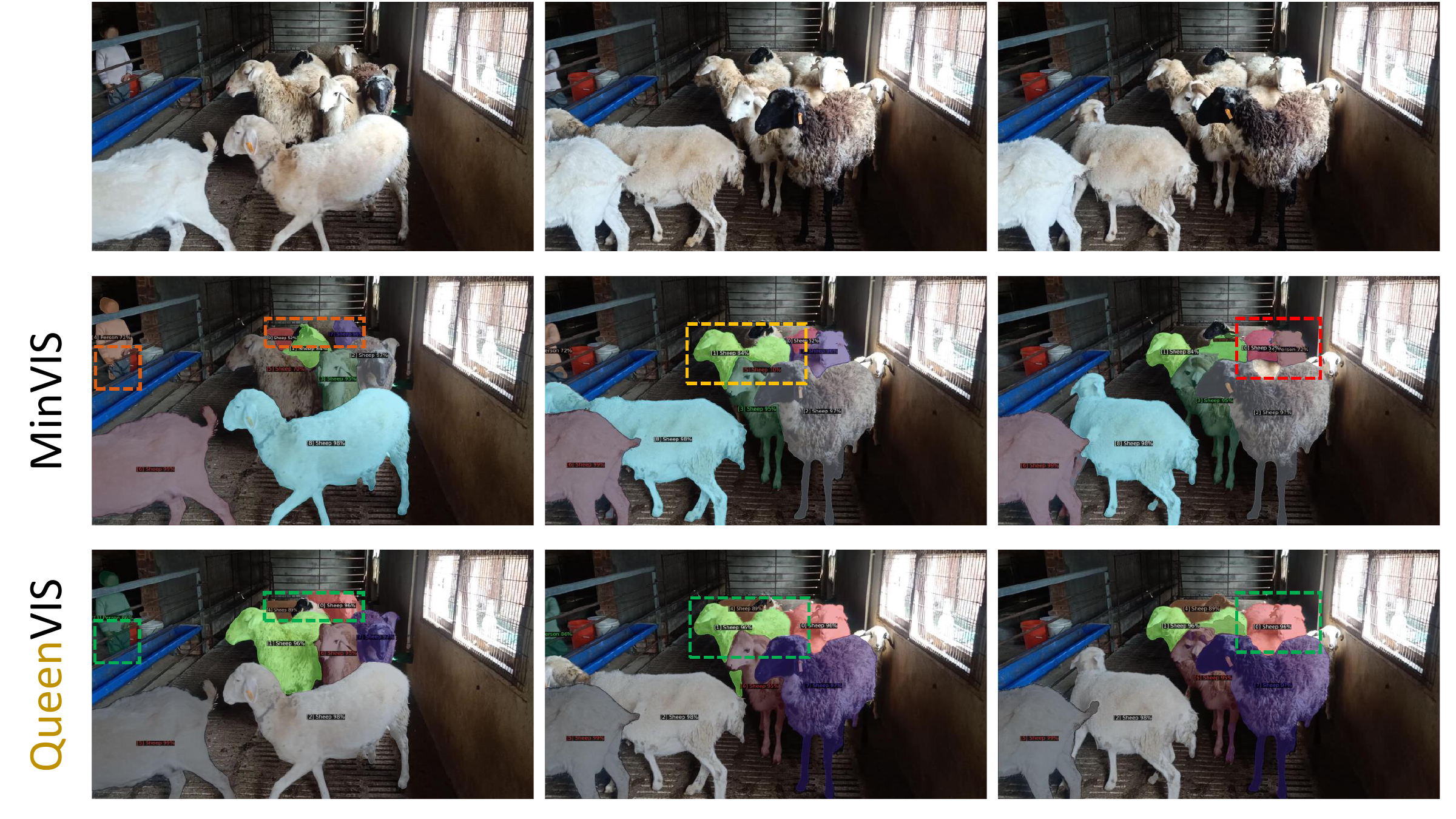
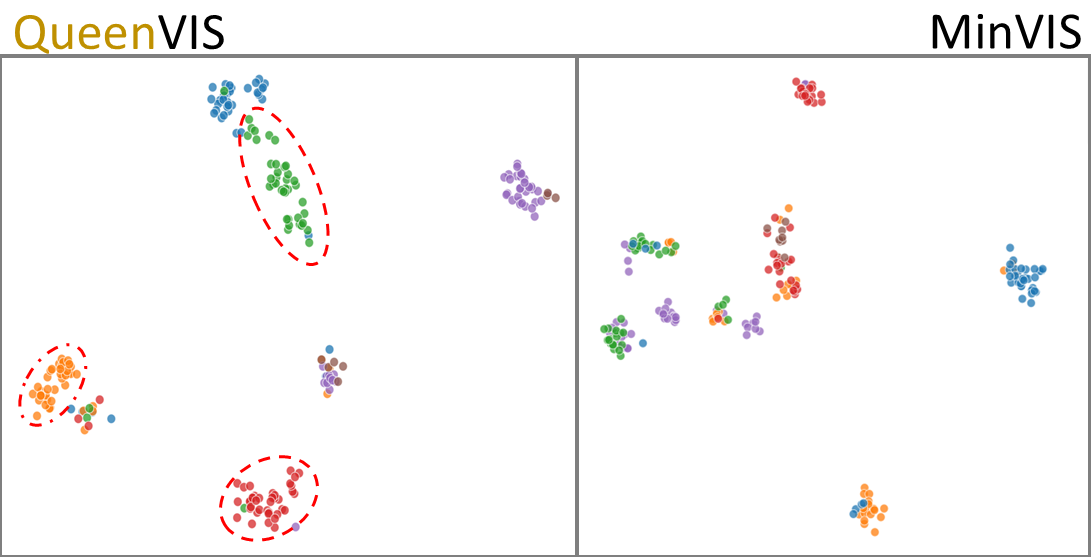
Strong spatial and appearance modeling can make image-trained object queries far more stable across time. QueenVIS treats query quality as a complementary research axis to increasingly complex video supervision.
@misc{kheirandish2026queenvisrethinkingimageonlytraining,
      title={QueenVIS: Rethinking Image-Only Training for Video Instance Segmentation via Query Enrichment},
      author={Arian Kheirandish and Fardin Ayar and Ehsan Javanmardi and Manabu Tsukada and Mahdi Javanmardi},
      year={2026},
      eprint={2607.24598},
      archivePrefix={arXiv},
      primaryClass={cs.CV},
      url={https://arxiv.org/abs/2607.24598},
}